Welcome to the first installment of my new history blog. This blog, which will range over centuries and continents, looks at people and events that fascinate me. I’m beginning with a 20th-century soldier who was also a lawyer.

© IWM
Robert Blair “Paddy” Mayne was born in 1915 in Northern Ireland. In the late 1930’s, he was a professional rugby player, legendary for his ferocity on and off the playing field. He would often sneak out of the team’s hotel to go drinking. The night usually ended in a brawl with other patrons of the pub.
Mayne might be remembered only as the bad boy of Irish rugby if not for World War II. He immediately enlisted in the Royal Ulster Rifles, a conventional military unit. Not surprisingly, he didn’t fit in well. Fortunately for Mayne, the Special Air Service (SAS) was created in 1941 and he immediately transferred to it.
The SAS was the brainchild of David Stirling, another misfit serving in a conventional British unit. His idea was to take a small mobile force behind enemy lines in the North African desert to attack enemy supply lines and Luftwaffe airfields. His idea was accepted because in 1941 the British were losing more often than winning.
 SAS recruits were trained as paratroopers. They did most of their training on the ground due to a lack of aircraft for training missions. How do you train a paratrooper without jumping out of an airplane? Paddy Mayne is credited with the solution: recruits jumped out of a jeep or truck moving at 30 mph while wearing full-kit (120 pounds).
After training, SAS personnel disappeared into the desert to begin attacking German airfields. A typical attack began with a few men infiltrating the enemy airfield and planting explosives on the planes. In the next phase of the attack, a larger unit would drive on to the airfield in jeeps to strafe the enemy troops responding to the bombs.
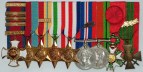
© IWM
When not in combat, Mayne continued his drinking and brawling habits. His insubordinate, hard-living behavior is believed to be the reason he was never awarded the Victoria Cross (the British equivalent of the Congressional Medal of Honor). After the war, he returned to his career as a solicitor.
Paddy Mayne is a fascinating man because of his contradictions. He was almost superhumanly brave in combat. But he never overcame the demons that triggered his drinking and brawling. He died in a road accident at the age of 40.
His exploits with the SAS are covered in Rogue Heroes (seen above) by Ben Macintyre (2016).
If your company is struggling with HR issues, Corporate Compliance Risk Advisor can help you create HR policies that are appropriate for your company’s size and then serve as a resource to your staff as the policies are implemented.
Interested in reading more highlights from history like this one? I’m building a whole new blog for them! It’s coming soon, but in the meantime, be sure to sign up to receive emails with each new blog. Sign up here!
Join the HR Compliance Jungle today. Click here!
 Finding the “right” employee is one of the most difficult tasks for any company. There will always be job applicants with the skills and expertise required for the job. But will the new hire fit in well with the existing team? A technically skilled person is so much dross if she or he has a toxic personality that destroys team morale.
 In World War II, U-boat captain Peter “Ali” Cremer was concerned about how new crew members would fit in with his existing crew. U-boats were claustrophobically tiny. There was no privacy and no room to separate crewmen if a dispute arose. Meanwhile, U-boats took weeks-long patrols looking for Allied convoys and risking enemy attacks.
 At the same time, Cremer was consistent in his approach to the job (i.e., his corporate culture). Every crew member was treated with respect and discipline was enforced the same for everyone. No unnecessary risks were taken with the boat or the crew. Across the fleet, every U-boater knew that Cremer always brought his crew back alive. That was important since only 10% of U-boaters survived the war.
 For more information about Peter Cremer, check out his memoirs
  HR Compliance Jungle