 Another update from the Jungle….
Cyndi has settled in well to her new role as a manager at her company. Her friendly attitude is helping her build solid client relationships. But Tom, the candidate who lost out when Cyndi was promoted, is nursing his sense of injustice.
Tom believes he was the victim of reverse discrimination. He thinks the company promoted Cyndi because they were scared by a former employee’s gender discrimination lawsuit. Initially, he sulked and nursed his wounded ego. But he’s not stupid; he knows that sulking won’t help him. So he does what any reasonably intelligent schemer does. He dreams up a diabolically clever plan to get even.
 First, he taps his network within the company to find out where there might soon be an opening for a manager. He learns that Stuart is retiring from his managerial slot as head of internal procurement. It’s an important job within the company but a graveyard for career aspirations. No procurement manager has ever received a promotion to the C-suite.
Tom begins maneuvering to have Cyndi promoted to Stuart’s soon-to-be-vacated job. Tom persuades a friend to encourage Cyndi to apply for Stuart’s job. He also anonymously encourages the HR manager to believe that Cyndi wants Stuart’s job. As a result, Cyndi is subjected to nudges, winks, and “discreet” inquiries about her interest in replacing Stuart.
 Cyndi is flattered by all the attention. It’s nice to be wanted. She knows that if she takes the job, she will be the head of an entire department and get a slight bump in pay. But Cyndi isn’t stupid either.
She knows she’s got a management job on the production (i.e., revenue producing) side of the business. Procurement is a cost center and not a revenue producer for the company. She knows that production-side managers are more likely to get promoted.
 What should Cyndi do next?
- She can apply for Stuart’s job so that she becomes the head of a department and gets the bump in pay; but accept that she’ll probably never get another promotion.
- She can recognize the Machiavellian plot to derail her career and start a counter campaign to get Tom promoted to the procurement job.
- She can hang on to her current managerial post and work toward a C-suite promotion.
Office politics are a feature of every company. For some, it’s a game that alleviates the boredom of their jobs while others see politicking as war with winners and losers. To limit the politicking, it helps to have clear HR policies that are fairly applied to all employees.
If your company is struggling with HR issues, Corporate Compliance Risk Advisor can help you create HR policies that are appropriate for your company’s size and then serve as a resource to your staff as the policies are implemented.
Join the HR Compliance Jungle today. Click here!




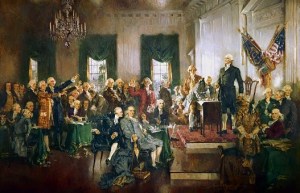 Building a successful team is never easy. Managers and business owners who hire “yes-men” tend to ride their egos and a false consensus to financial ruin. On the other hand, having too many different opinions can paralyze decision-making and cause companies to fall apart. What should an intelligent manager or business owner do?
 Hamilton wanted a strong central government and an industrialized economy. Jefferson wanted a weak central government with most power residing with the states and an economy based on agriculture. These conflicting visions of America are as strong today as they were over 200 years ago.
 Washington kept his feuding Cabinet members functioning as a team, and he did it while building the political structure of the U.S. from scratch. The traditions we esteem today were created by Washington to work around the political battles in his Cabinet and with the leaders of Congress.
 Building a functioning team means having calm, assertive leadership that listens to all viewpoints before making a final decision. Washington was one of the best at it.
 If your company is struggling with HR issues, Corporate Compliance Risk Advisor can help you create HR policies that are appropriate for your company’s size and then serve as a resource to your staff as the policies are implemented.
 Dawn, the Chief Talent Officer for her company is happy for the first time in months. The election is over! The chips have fallen. She no longer cares who won.
 half is snarling that the election was rigged. Dawn sighs deeply and wades into the group, greeting everyone by name. To encourage them to actually enter the building, she promises something “special” for lunch at company expense.
 Dawn calls a local bakery to order a cake for the impromptu TGIO party. Apparently, many people are having TGIO parties because the bakery sold out of cakes. Dawn orders a mix of crème puffs and cookies. She is determined to have a cheerful lunch.
 difference between the popular vote and the Electoral College vote. Dawn cuts him off in mid-sentence. She has a really important job for him, she says. She needs him to go to the local big box store to buy supplies for the party. She’ll reimburse him, she promises.
 Dawn is the HR manager for her company. Five years ago, her title was HR Director. Then it was changed to Chief People Officer before changing again to Chief Talent Officer. These days, she thinks her title ought to be Chief Therapist.
 election. She’s investigated several complaints of discrimination and sexual harassment as everyone becomes hyper-sensitive in response to the latest election news headline. A recent example is Monica who complained of a hostile workplace and named Steve as the perpetrator.
 Dawn’s investigation findings are underwhelming. It turns out that twice in as many days, Steve drank the last cup of coffee and didn’t start a new pot brewing. Monica thinks he did it deliberately to disrespect women by forcing a woman to brew a new pot. Steve says he was in a hurry and simply forgot. He says Monica hates him because he was promoted before her. Dawn tells Monica and Steve in polite HR-speak to grow up.
 Doom. Helen comes to Dawn’s office every morning with a coffee mug the size of a soup bowl, plops down in the spare chair and doesn’t leave until she needs a refill. Helen is a worrier. Her latest worry is that the political arguments among co-workers will degenerate into fist fights. She says she doesn’t feel safe walking around the office.
 Helen could hide in her cubicle actually doing her job and ignoring the political fights around her, suggests Dawn. Helen explains for five minutes exactly why that wouldn’t work for her. Dawn asks if Helen wants to use accrued vacation days to stay at home. Helen says she doesn’t have enough accrued leave to stay home for the next three weeks and drifts away for a refill.
 Alana always felt like a misfit, so when she started her own business, she decided to hire people like herself. Alana’s company sells works of art ranging from paintings to furniture. Oddballs seem to be more at home in the world of unique “art”.
 They instantly boosted sales due to their smooth handling of customers. Art wasn’t the only thing they sold at Alana’s shop. Evan and Elsie had a side business growing high quality marijuana. To encourage sales, they invited customers to sample the good in the parking lot behind the shop.
 Shrieking like a banshee, she chased off the customers. Then she explained to Evan and Elsie that de-criminalizing marijuana was not the same thing as legalizing it. She threatened


 Corrie is bored with her job. It hasn’t challenged her skills in years or put her in line for a promotion. She’s tried to find other jobs but the truth is that she’s unlikely to get a big enough salary increase to offset the loss of her current benefits package.
 To pass the time and alleviate her boredom, she creates imaginary scenarios for her job. When her boss gives her a new assignment, she pretends its part of a great military plan, like Operation Overlord. She imagines herself working in a small office in London, helping plan the D-Day invasion.
 When she takes a business trip, she pretends she’s an agent dropped into occupied France to support the French Resistance. As she drives, she thinks of the highway patrol as roving bands of collaborators looking for Resistance workers they can arrest and interrogate. When she checks in to a hotel, she scouts the lobby for exits in case she needs to beat a quick retreat from a Gestapo raid.
 But Corrie stopped caring after the management team downsized the workforce. She’s survived several staff reductions since the first big cull of the herd by keeping her head down and her opinions to herself. She no longer volunteers for special projects but her past volunteerism means her boss considers her a “team player” and Corrie thinks that’s helped her keep her job.


 Grace is an assistant manager for her company. She’s always looking for opportunities to improve her performance so that she can get promoted. She hears that Diane believes in mentoring young talent and asks for a transfer to Diane’s department.
 She decides to not bail out herself because she believes she is in line for a promotion that is opening soon. The company has a policy that requires an employee to be in a position for at least a year before being eligible for promotion.
 HR Compliance Jungle